Roomies and zoomies: Reflections on LocalGov Drupal Dev Days

Tony is a Drupal frontend specialist. He brings many years of experience in balancing design, performance, accessibility and usability to realise objectives and bring user experiences to life.

Annertech developer Tony Barker swapped the Northumberland rain for the London drizzle to attend the inaugural LocalGov Drupal Dev Days. Held at Space4 in Finsbury Park, the event brought together the ‘roomies’ (those in the building) and the ‘zoomies’ (those joining remotely) for two days of deep-dive learning and collaborative coding. Here is Tony’s account of the event.
Introduction
Travelling to King’s Cross on a February Tuesday for the next day’s inaugural LocalGov Drupal Dev Days, of which Annertech is a proud sponsor, my hopes for relief from the overcast Northumberland skies and the downpours of previous weeks were quickly dashed.
Nevertheless, I sought some music therapy at the Gibson Garage and took in the sights, eventually finding myself equidistant between Tottenham Court Road and Covent Garden just as the heavens opened spectacularly, so I took refuge in Seven Dials Market.
Day 1: The learning day
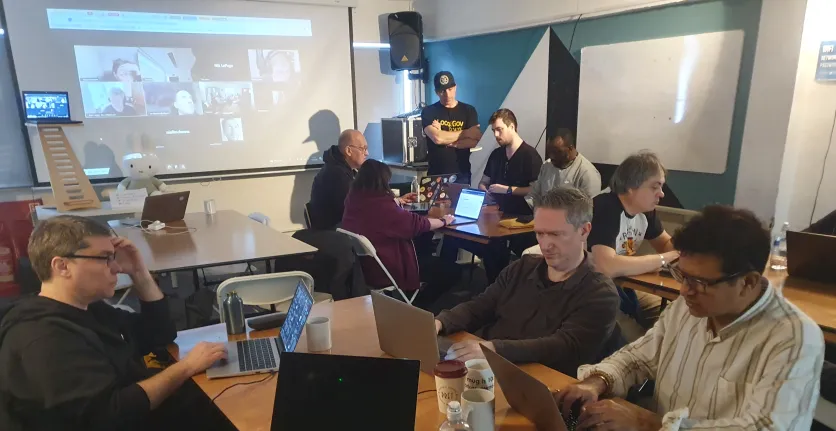
Our venue, Space4 in the heart of Finsbury Park, is a brilliant community workspace.
After tea and biscuits in the kitchen, we settled into the main room where the LocalGov Drupal team Tim Hunt, Aaron Hirtenstein and Finn Lewis had performed some audiovisual wizardry with screens and mics.
It ensured our connection to those joining via Zoom felt like one continuous, shared space.
Accessibility and the balance of labels
Maria Young from Agile Collective opened with a session on accessible labels. Using a tricky case involving search facets in directories and microsites, we explored the fine balance between verbose labelling and overwhelming the user.
It struck me that before we can master the markup tools available to us, we need to understand exactly what labels screen readers are describing. For a sighted developer, I think that a great first step is simply unhiding those labels visually.
Maria also highlighted the importance of maintenance; if aria labels diverge from visual text, they are less likely to be updated over time. Using aria-labelledby is a useful method for ensuring the screen reader experience keeps pace with visual changes.
The power of “Finders”
Two related talks from Andy Broomfield (Brighton & Hove) and Joachim Noreiko brought home the potential of the “Finders” initiative. Andy demonstrated some great UX improvements to directories and events powered by Ajax. Traditionally, filtering has been disjointed, requiring a full page reload, but moving to Ajax yields a better experience.
Joachim then presented Finders, which aims to bring parity to code and experience across directories, events, news and consultations. It replaces the need for developers to build bespoke lists and hands power to editors to build channels and listings, with a better end experience for users “finding” what they need through a unified framework.
One talking point in the room was blocking issues for a stable version of “Finders powered events”. Although upgrade paths will need to be considered for Directories and News, for Events this may not be required. Because events organically expire, it may be that old events are allowed to expire whilst new events can use the new feature.
Complex transaction workflows
The hybrid nature of the event really shone during the session on transaction workflows. Agile Collective’s Simon Chapman and Ekes presented from the room while Pardeep Singh joined from the Walsall office.
As we well know at Annertech, planning applications are a complex business under the hood, and the real art lies in making the front-end experience intuitive. Simon and Ekes role-played the application process away from the tech, which was a fun and enlightening way to showcase the logic.
Day one rounded off with a chance for the group to unwind at the dining table of Pappagone's, not far from Space4, courtesy of Agile Collective. The Calzone comes highly recommended.
Day 2: The contribution day
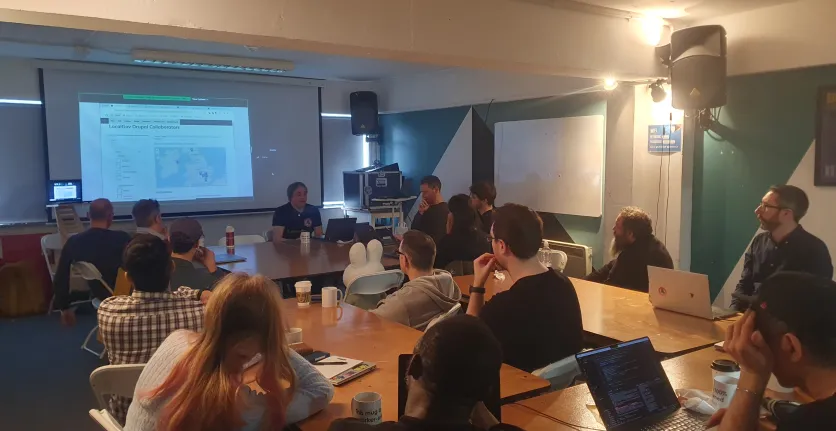
My focus for the second day was to be “hands-off” with coding and “hands-on” with facilitation to assist with the nuts and bolts of code contributions, reviewing work and to keep things flowing.
Supporting first-time contributors
Whilst the experience of contributing to LocalGov Drupal has improved since migrating the projects from Github to Drupal.org, there is still something of a learning curve. Drupal.org is transitioning to using Gitlab issues, so the workflow is a little disjointed at present.
To guide the process, Finn and I curated the LocalGov Drupal Ladder. Inspired by the somewhat legendary Drupal ladder, it documents a series of steps to help people move from navigating issues to achieving their first commits.
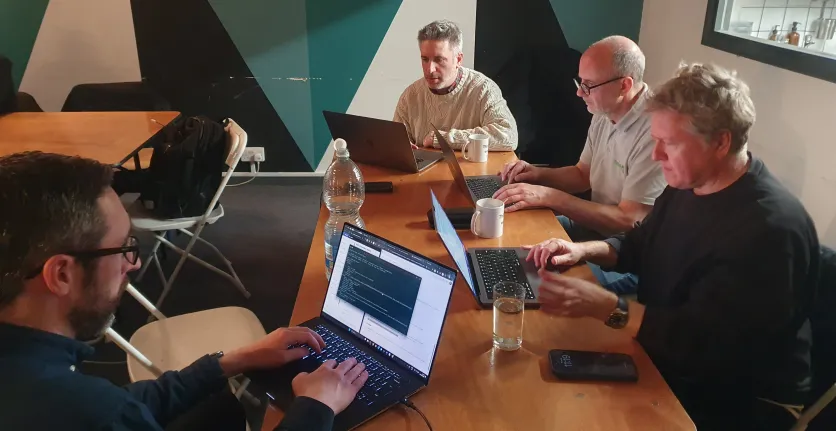
This worked really well. Facilitated by Finn and myself, first-time contributors at Finsbury Park achieved at least one commit. Stephen Cox, Maria Young and Mark Conroy facilitated on Zoom, and together we merged and closed 20 issues, gaining valuable insights along the way on how to make the onboarding process even smoother.
Stephen’s live walkthrough was recorded and is available on YouTube
Pushing for a stable Elections release
A major target for the day was achieving a stable release for the LocalGov Elections module. The latest work includes support for multiple seats per ward, improvements to boundary source handling and improved accessibility of charts.
As well as code, logic and feature review and improvements, some adjustments were needed to phpunit tests because the Elections demo content installation was colliding with some of the new code in Drupal.org’s strict test environment.
Resolving these collisions required teamwork, showcasing the true power of open-source collaboration. Whilst we didn’t quite hit the “stable” button due to a remaining release blocker regarding some important language, we are very close.
Final thoughts
It was a great pleasure to see familiar faces and welcome so many new contributors to the project. It was nice to thank Lee Mills in person for his work contributing the LocalGov analytics app – a tool that makes our daily work easier by providing a clear status overview of all LocalGov modules.
Every single person in attendance over the two days deserves thanks for playing their part in the success of the inaugural LocalGov Drupal Dev Days.
Events like these remind us that whilst the code is important, it’s the community and the shared mission of simplifying life for citizens that really drives LocalGov Drupal forward.
Tony is a Drupal frontend specialist. He brings many years of experience in balancing design, performance, accessibility and usability to realise objectives and bring user experiences to life.
Related Blog Posts
-
-
 18 August 2026
A year in the LGD Developer role. What can we achieve today?
-

Thinking about making the move to LocalGov Drupal?
Our participation in LocalGov Drupal Developer Days is a key part of Annertech's ongoing commitment to the LGD project. We don't just use the platform; we help build it.
We’d love to share our expertise and help your council get started.